
Biography:
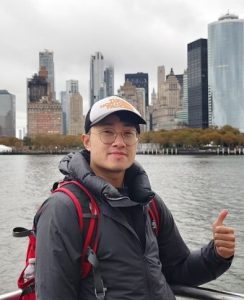
Dr. Hanxun Yao, Professor in Modern Mechanics at USTC. He earned his MPhil and PhD from the University of Sydney (2015-2017) and Imperial College London (2018-2022) in Computational Fluid Dynamics and Turbulence. From 2022 to 2025, he worked as a Postdoctoral Fellow at Johns Hopkins University, focusing on turbulence theory and the Johns Hopkins Turbulence Databases (JHTDB). His research group on fundamental and environmental turbulence, with emphasis on multiscale dynamics, the energy cascade, intermittency, and turbulence entropy.
He has published in Journal of Fluid Mechanics (JFM), Physical Review Fluids (PRF), Physical Review Letters (PRL), Philosophical Transactions of the Royal Society A, Journal of Turbulence, etc. His original work, bridging turbulence theory and statistical mechanics, has been reported in Physics Magazine and has earned him the Journal of Fluid Mechanics Emerging Scholar Best Paper Runner-up Prize and the Corrsin-Kovasznay Outstanding Paper Award.
Research Interest:
Turbulence modelling (DNS, LES); theory (energy cascade, intermittency, scaling laws); turbulence databases; and applications in engineering (wall-bounded flows, elastic turbulence) and environmental flows (2D turbulence, Rayleigh-Bénard convection, stably stratified atmospheric boundary layers, magnetohydrodynamics).
What You Can Expect in the Project:
Students will gain a foundation in fundamental turbulence theory and have access to the world’s highest-resolution turbulence databases, encompassing flows from simple (homogeneous isotropic turbulence) to complex (wind farm) geometries. Using these state-of-the-art resources, students will be able to test and verify theoretical equations that, until now, have primarily been examined only in textbooks and seminal publications. By applying novel statistical, mathematical, and AI-driven methods to analyze turbulence data, students will have the opportunity to extract/uncover new insights and explore novel physics within turbulent flows.
Desired skill and background:
Calculus, statistics, fluid dynamics, and Python programming.